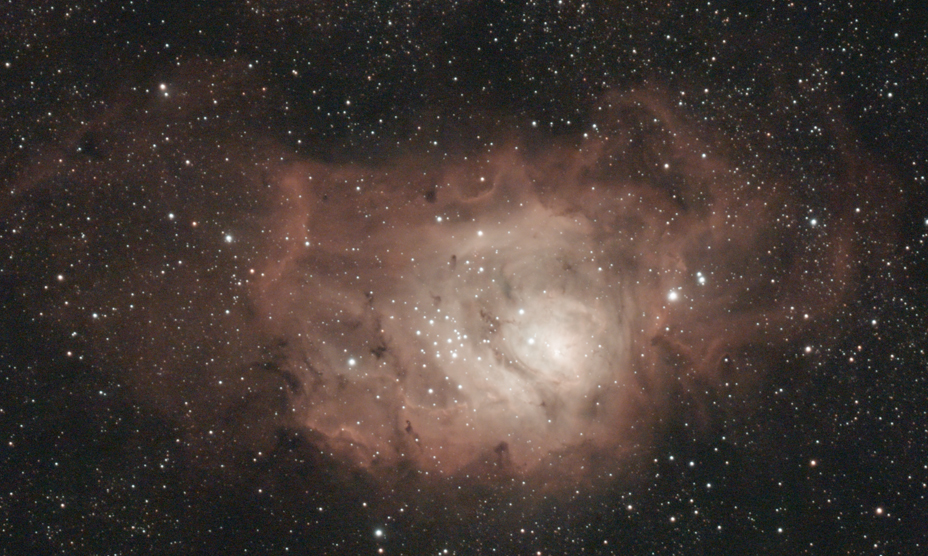
Messier 8 – The Lagoon Nebula
The image in this article was reprocessed using improved tools and techniques. To see the original image, click here.
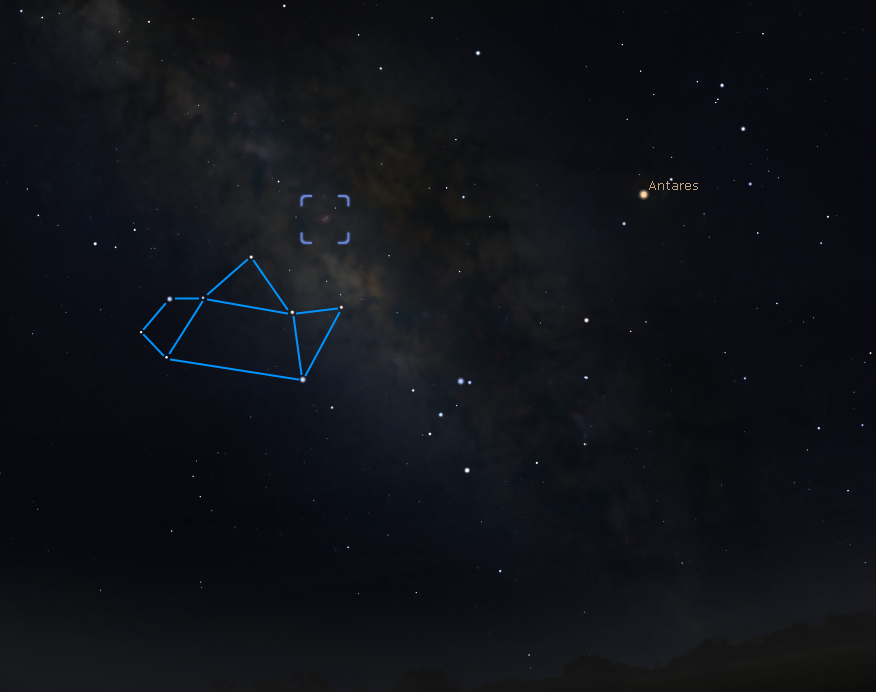
If you live in the mid- to lower-latitudes of the northern hemisphere, go outside right after dark on a clear night in mid-summer, look to the south, and search for the eight bright stars that make up the Teapot asterism in the constellation Sagittarius. The Milky Way will look like steam rising from the spout! (If you live in the southern hemisphere, go out after sunset in the winter and look up and a little to the east.)
If the sky is dark enough you may see a small, fuzzy patch that almost forms an equilateral triangle with the star at the top of the lid and the star at the tip of the spout. That is the Lagoon Nebula!
The Lagoon Nebula, also known as Messier 8, is a vast cloud of gas and dust about 4,000 to 6,000 light years away roughly in the direction of the center of the Milky Way. NGC 6530, a cluster of thousands of young, bright stars, is located within the nebula. Ultraviolent radiation from the stars ionizes Hydrogen atoms in the surrounding nebula, causing the gas to glow red.
The nebula in the upper left that resembles a paw print is cataloged as NGC 6559.
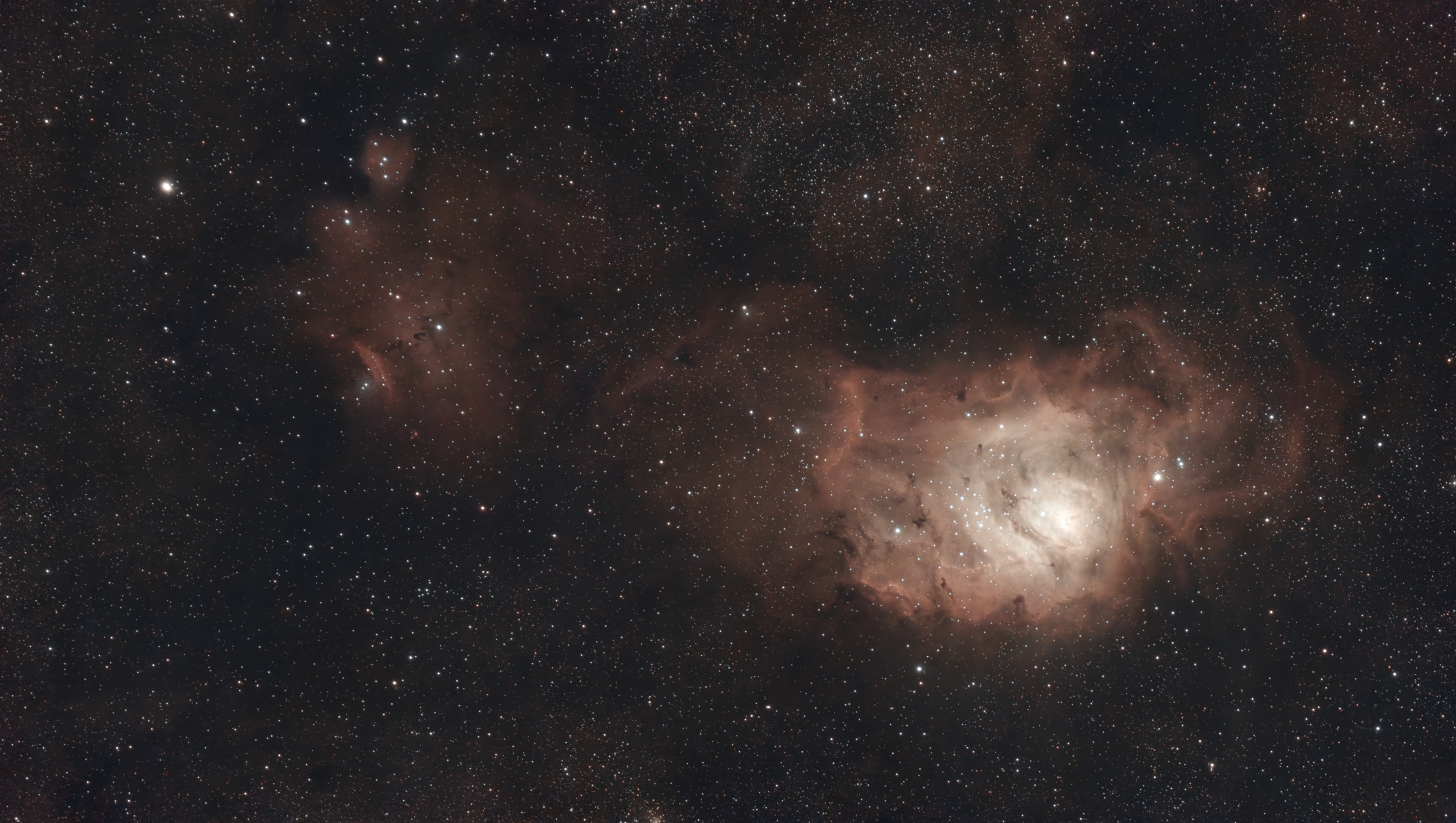
Click on the link below to view the full-size version of this image:

Leave a Reply