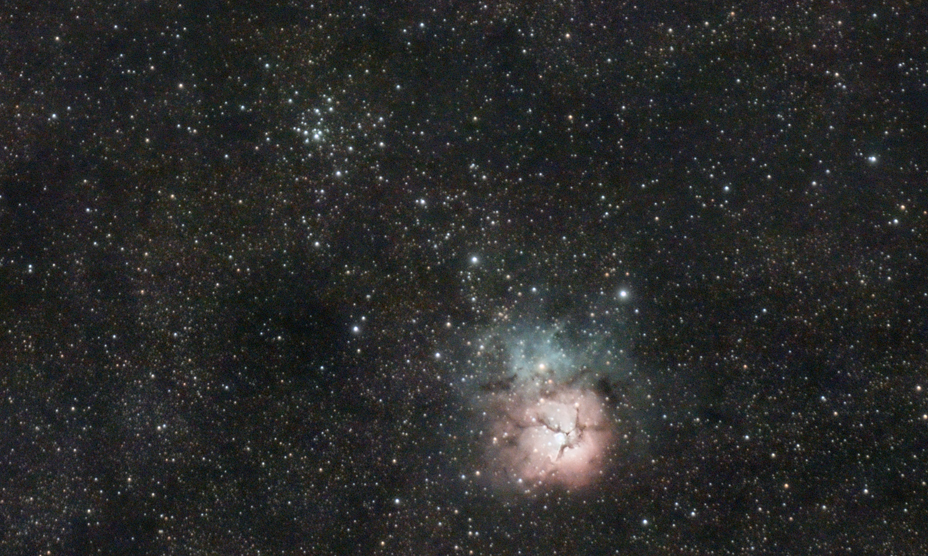
Messier 20 – The Trifid Nebula, and Messier 21
The Trifid Nebula is located a little above the Lagoon Nebula when viewed facing south in the northern hemisphere. It is an interesting mixture of emission, reflection, and dark nebulae that is easily viewed in a small telescope. It’s even more spectacular in long-exposure images!

Click on the link below to view the full-size version of this image:
Messier 20 – The Trifid Nebula, and Messier 21
Hydrogen atoms, which are being energized by ultraviolet light from stars within the nebula, emit red light. The blue part of the nebula is from dust and gas that is reflecting starlight. The dark portions are thick clouds of dust and gas that block the light from our perspective.
The nebula’s name comes from how the red portion is divided into three parts by the dark nebula that sits across it from our point of view. That dark nebula, by the way, is named Barnard 85.
The exact distance of the Trifid Nebula is unknown. Estimates range between 2,200 and 9,000 light years. That’s a lot of uncertainty!
The dark streaks that hide the stars in the areas surrounding the nebula are vast clouds of interstellar dust and gas that lie along the plane of the Milky Way. Faint red clouds of glowing Hydrogen gas can also be seen.
Above and to the left of the Trifid Nebula in the image is an open cluster of stars cataloged as Messier 21. Also known as Webb’s Cross, it is located approximately 3,900 light years away and is not associated with the Trifid Nebula.
Ten years ago, I created a mosaic image of the Lagoon and Trifid Nebulae and the surrounding area. That image, as well as others, can be viewed on my old astronomy blog:

Leave a Reply