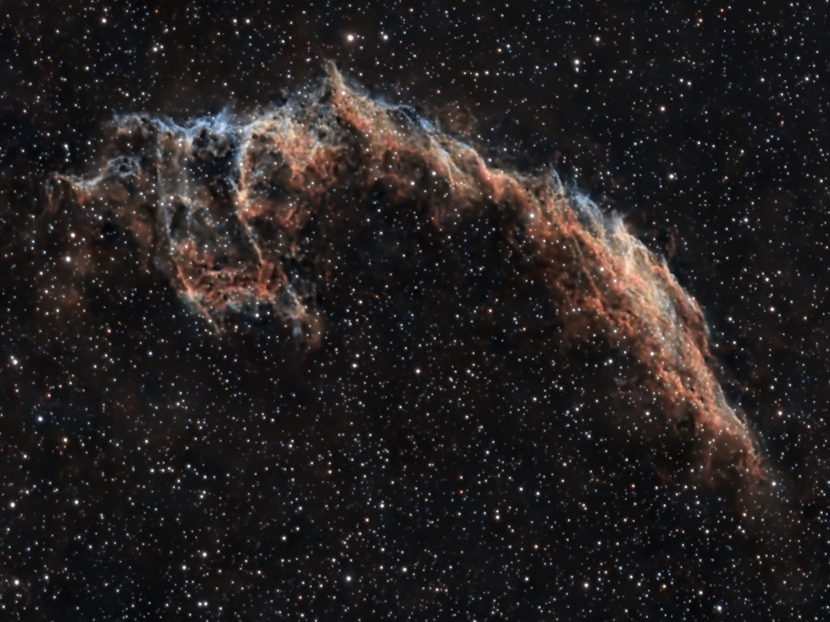
Cygnus Loop
The Cygnus Loop is a supernova remnant located off the western wing of Cygnus, the Swan. Although faint, the nebula is huge from our point of view, spanning six times the width of the full Moon. It can be viewed in a small telescope, but most of the light coming from the Cygnus Loop is at wavelengths not visible to the human eye. Still, the visible portion is among the most beautiful objects in the sky.
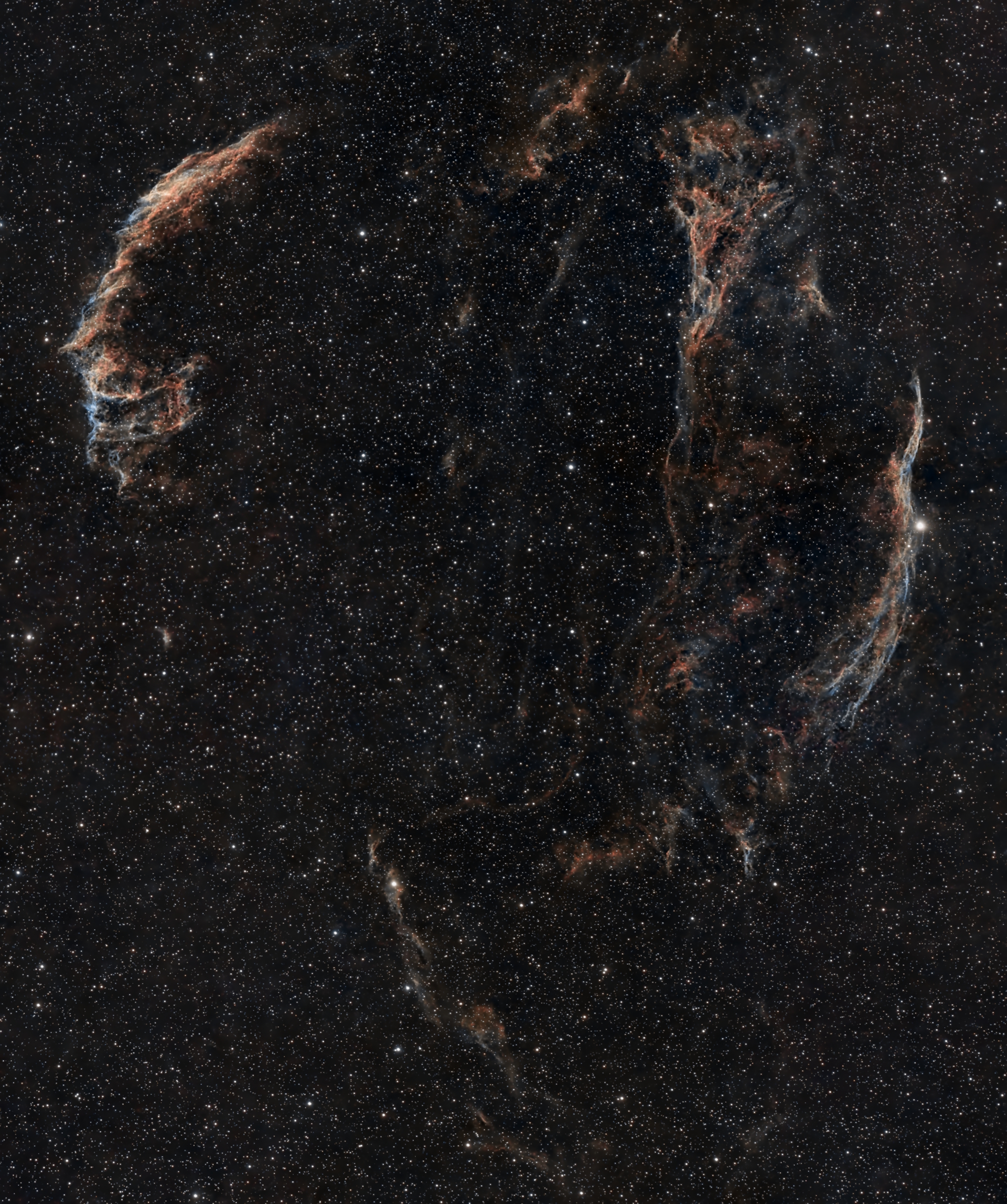
This image is a combination of six separate images made over the months of August and September 2026, plus one image made in October 2025, totaling about 16 hours of exposure time. All images were captured using my Dwarf 3 smart telescope and then processed in Siril.
The exact distance of the Cygnus Loop, and thus its size and age, has been studied and debated for a long time. A recent study by the McDonald Observatory has determined that the nebula is between 2,400 and 2,600 light years away, 120 light years across, and approximately 21,000 years old (give or take a few thousand years).
The Cygnus Loop is composed of several separately identified nebulae. The most prominent of these are the Eastern Veil, the Western Veil, and Fleming’s Triangular Wisp.
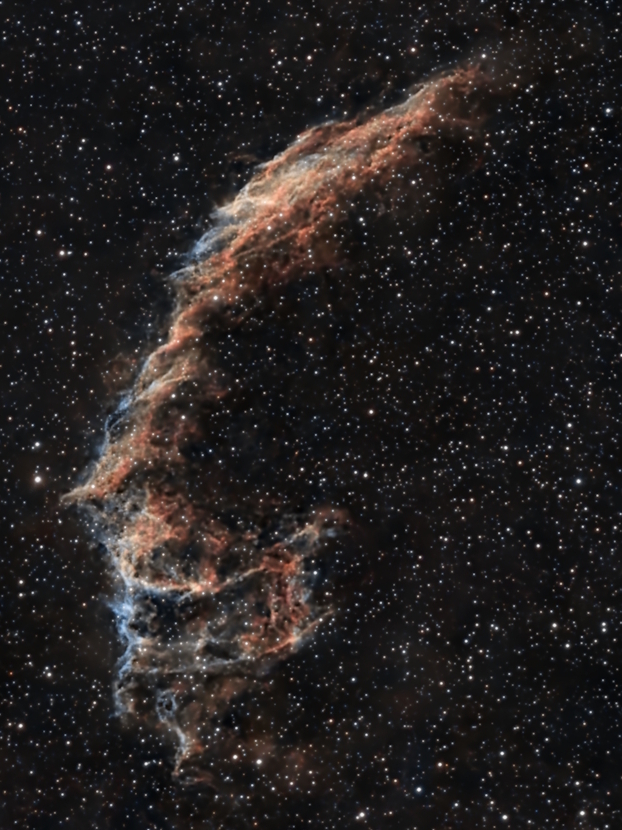
The Eastern Veil is composed of multiple separately-cataloged objects: NGC 6992, NGC 6995, and IC 1340. It is sometimes called the Bat Nebula because Batman uses it to fight crime. Not really. It just kinda looks like a bat.
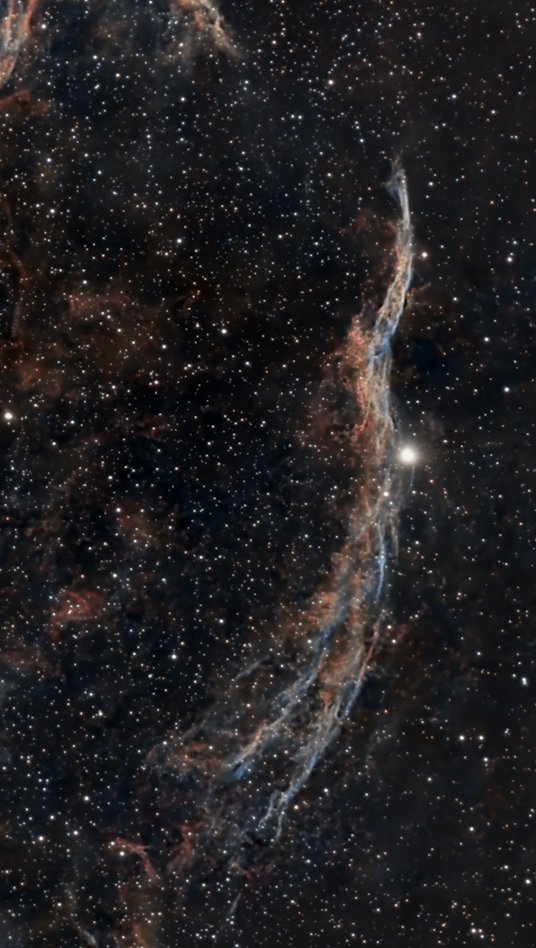
The Western Veil, NGC 6960, is often called the Witch’s Broom. The star 52 Cygni, prominent in this image, could be the witch riding her broom!
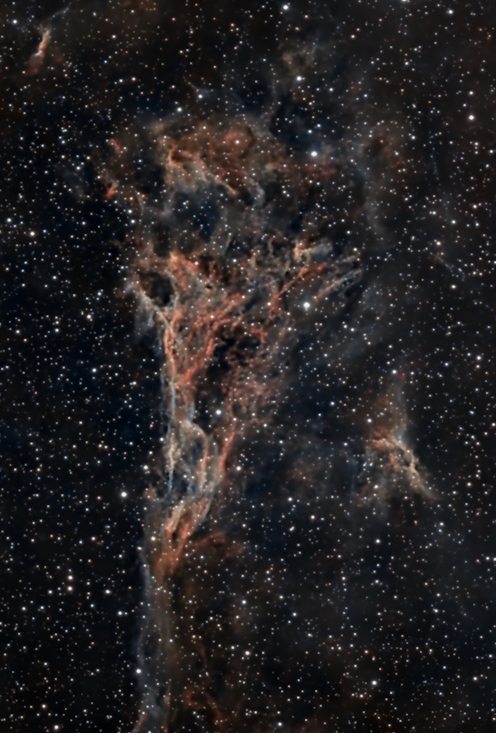
Fleming’s Triangular Wisp was discovered by Williamina Stevens Fleming at the Harvard College Observatory in 1904. Fleming’s life story is quite fascinating, and I encourage you, dear reader, to read the articled linked in the previous sentence. She made major contributions to astronomy despite a rather unremarkable start in life. The first known white dwarf star, hundreds of variable stars, and the Horsehead Nebula are listed among her many discoveries. She also wrote thousands of volumes on her scientific research, which as of 2017 were in the process of being digitized for easy reference.
Fleming’s Triangular Wisp is often called Pickering’s Triangle, after Edward Charles Pickering, who was the director of the Harvard College Observatory when the nebula was discovered. Naming a significant astronomical discovery after the director of the observatory that found it was a common practice at the time. More recently, however, an effort has been made to give credit to the nebula’s true discoverer.
Where there’s a supernova remnant, there must be a remnant of the star that created it. Astronomers have been searching for that remnant—a neutron star or a black hole—for a long time. Nothing has been found near the nebula’s center, but a potential candidate for a neutron star has been found south of the nebula (from Earth’s perspective). If this object is, in fact, a neutron star and is the progenitor of the Cygnus Loop, then it was violently ejected from its original location when it exploded due to a phenomenon called a “pulsar kick.”
For over 100 years now, astronomers have been studying and puzzling over the Cygnus Loop, and we still don’t have all of the answers. Maybe someday, another person with humble beginnings will come along and make a major discovery about the origins of this beautiful nebula.
Click on the link below to view the full-size version of this image:

Leave a Reply